Physical Address
304 North Cardinal St.
Dorchester Center, MA 02124
Physical Address
304 North Cardinal St.
Dorchester Center, MA 02124

Latest Car News, Reviews, Comparisons & EV Updates
Latest Car News, Reviews, Comparisons & EV Updates

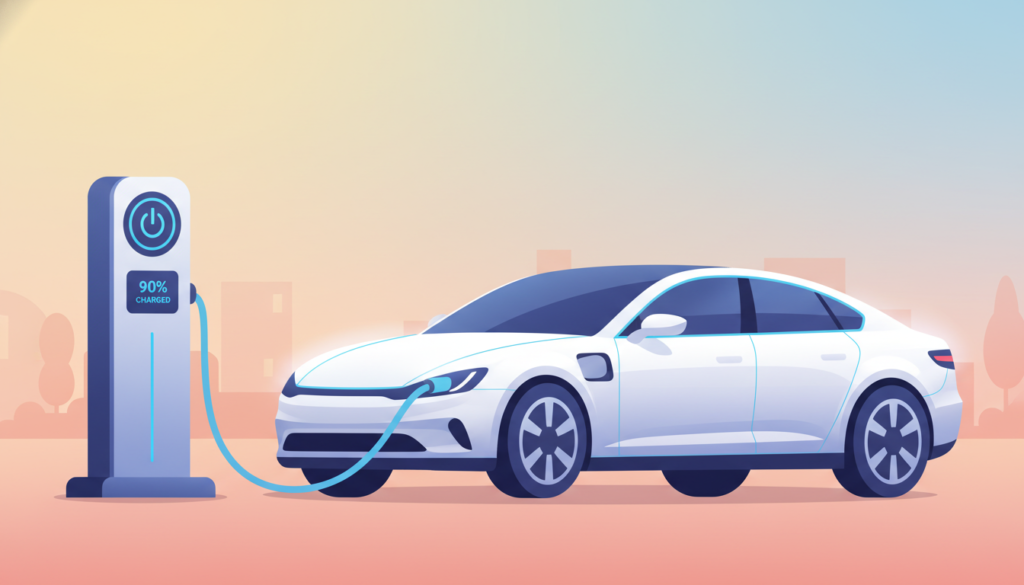
If you’ve ever wondered about EV charging — what is it really? — the simplest answer is this: it’s the process of refilling your electric vehicle’s battery pack using electricity from an external source, much like charging a large smartphone.
Every charge session involves three key components: the EVSE (Electric Vehicle Supply Equipment) — the correct name for a “charging station” — the charging cable and connector, and your car’s onboard charger and Battery Management System (BMS). The BMS monitors temperature, current, and voltage to protect your battery during every session.
For standard AC charging, your car’s onboard charger converts alternating current from the grid into the direct current (DC) the battery stores. With DC fast charging, this conversion happens inside the charging unit itself, delivering power directly to the battery — which is why it’s so much quicker.
Not all electric car charging works at the same speed. The level you use determines how fast you charge:
~5 mph
120V household socket. Best for overnight top-ups or plug-in hybrids.
~25 mph
240V dedicated wallbox. The go-to for daily home and public charging.
~200 mph
Up to 350 kW. Adds 200+ miles in under an hour. Ideal for road trips.
For most drivers, vehicle charging at home on a Level 2 wallbox covers everything. You plug in overnight, wake up to a full battery, and never think about it again. DC fast chargers are best saved for long journeys, as frequent use can gradually wear battery cells due to the heat generated at high power rates.
Understanding electric car charging voltage and current helps you make sense of charger specs and why some charge faster than others. Think of electricity like water in a hose:
Voltage (V) is the pressure — the electrical “push.” Current (in amps, A) is the flow rate. Multiply the two and you get power in kilowatts (kW) — which is what determines charging speed. A 240V supply at 32A delivers 7.68 kW. A 400V DC fast charger at 375A delivers 150 kW — roughly 20 times faster.
This is why charging electric vehicles at a higher voltage level is so impactful: even a modest increase in voltage dramatically raises the power your battery can accept per hour.
Your battery is your EV’s most valuable component. Smart EV battery charging habits can significantly extend its life:
Stay in the 20–80% range. Lithium-ion cells degrade faster at the extremes. Most EVs let you set a charge limit — 80% is the recommended daily cap. Only charge to 100% when you genuinely need the extra range for a long trip.
Use fast charging sparingly. High-current charging of EV generates heat, and heat degrades battery cells over time. Use DC fast chargers for road trips; rely on your home wallbox for everything else.
Charge in moderate temperatures. Extreme cold or heat impacts both charging efficiency and battery health. Enable your car’s battery pre-conditioning feature before charging in very low temperatures — most modern EVs support this.
Quick Win
Set your car to charge on a schedule. Charging during off-peak hours — typically overnight — is cheaper and reduces strain on the grid.
Home charging is the most affordable option. At around ₹32–₹35/kWh, filling a 77 kWh battery from 20% to 100% costs roughly ₹1,900–₹2,300 — far cheaper than a similar petrol fill-up. Public AC chargers typically cost ₹40–₹70/kWh, while DC fast chargers can range between ₹85–₹110/kWh depending on the charging network and location. Despite the higher fast-charging cost, EVs still offer significantly lower running expenses compared to petrol and diesel vehicles. (wise.com)
If you can charge at home, truly understanding electric car charging quickly translates into hundreds of pounds saved every year.
Electric car charging is simpler than it looks. Choose the right level for your lifestyle, keep your battery in the middle range, and charge at home whenever possible. The switch to electric is easier — and cheaper — than most people expect.