Physical Address
304 North Cardinal St.
Dorchester Center, MA 02124
Physical Address
304 North Cardinal St.
Dorchester Center, MA 02124
Latest Car News, Reviews, Comparisons & EV Updates
Latest Car News, Reviews, Comparisons & EV Updates
My neighbour bought a diesel sedan last year. Beautiful car, great mileage — but he drives 25 km a day, mostly in Lucknow traffic. Three months in, he’s spending more on DPF cleaning than he ever saved on fuel. Nobody told him diesel engines need highway kilometres to stay healthy. His bad luck is your lesson.
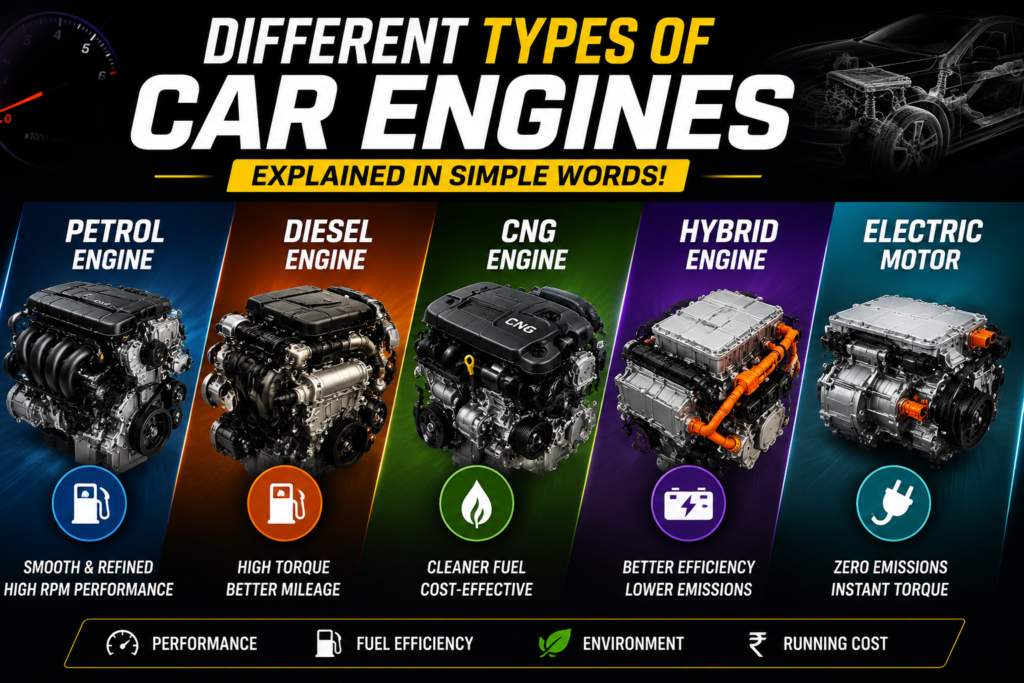
Engine type is probably the most important decision you’ll make when buying a car in India, and somehow it’s the one people research the least. Everyone obsesses over colour, sunroof, and infotainment screens — and then picks petrol or diesel based on what their chacha drove in 2015. That’s not how it works anymore. The market has changed completely. You now have turbo petrol, CNG, mild hybrid, strong hybrid, and full EVs sitting on the same showroom floor. Let’s break all of it down — simply.
Think of an engine as a machine that converts fuel (or electricity) into movement. A traditional petrol or diesel engine — called an Internal Combustion Engine (ICE) — burns fuel inside cylinders. That controlled explosion pushes pistons, which spin a crankshaft, which eventually turns your wheels. It’s loud, it’s hot, and it’s been around for over 100 years.
Electric motors are a different story entirely. No burning, no cylinders, no exhaust smoke. Just a battery pack pushing electricity through a motor that turns your wheels. Instant power, whisper quiet. But we’ll get to that.
Here’s what your engine choice actually affects every single day: fuel bills, how the car feels to drive, what breaks first, and how much you spend fixing it. Get this right, and the rest of the car almost doesn’t matter.
Walk into any showroom, and the salesperson’s default pitch will be petrol. And honestly? For most Indian buyers, they’re not wrong.
Petrol engines mix air and fuel, compress it, and ignite it with a spark plug. Simple, proven, and refined over decades. Modern petrol cars — like the Maruti Swift, Hyundai i20, or Kia Seltos 1.5L NA — are smooth, quiet at idle, easy to maintain, and genuinely good to drive in city traffic.
Why people love them:
The honest downside: Running costs are higher than diesel. If you’re doing 2,000+ km a month on the highway, the maths don’t work in petrol’s favour. But for 800–1,200 km of city driving? Petrol is absolutely fine.
Diesel was the engine of choice for every SUV buyer in India through the 2010s, and for good reason. More torque, better highway mileage, and a satisfying punch when you press the accelerator on an open road.
Diesel doesn’t use a spark plug. It compresses air so intensely that the diesel fuel ignites on its own. That compression is what gives you that thick, pulling power — the reason cars like the Mahindra Scorpio N, Hyundai Creta Diesel, and Tata Harrier feel so effortless on a highway overtake.
Real talk on mileage: A diesel SUV doing 17–20 km/l on the highway genuinely changes your monthly fuel spend
. For someone driving 3,000 km a month, the savings on petrol can be ₹4,000–6,000 per month. That adds up.
But here’s what they don’t tell you at the showroom:
Drive less than 1,500 km a month in the city? Diesel probably isn’t for you.
Turbo petrol is a smart choice most of the time, but not always — and that’s worth understanding before you decide.
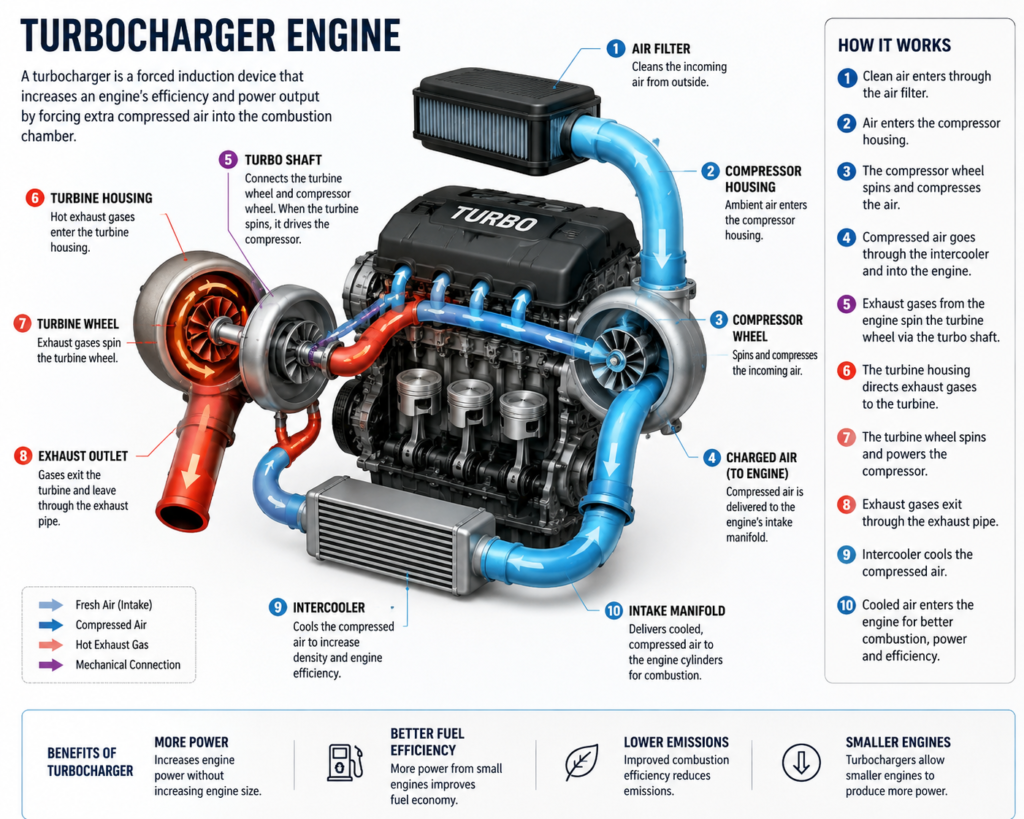
The basic idea is simple. Your engine produces hot exhaust gases while running, gases that normally just escape and go to waste. A turbocharger catches those gases, uses them to spin a small fan, and that fan pushes extra air back into the engine. More air, more power — from a smaller engine. That’s why a 1.0-litre turbo in the Volkswagen Virtus or a 1.5-litre in the Skoda Slavia punches well above what the engine size suggests. The Hyundai Verna turbo petrol is another good example — press the accelerator on a highway, and it responds sharply, without the hesitation you’d feel in a normal petrol car of similar displacement.
The catch is city driving. In stop-start traffic, the turbo never really gets into its stride, mileage drops noticeably, and the advantage over a plain petrol engine shrinks fast. So if your daily drive is mostly highway, a turbo petrol makes a lot of sense. If it’s mostly city, the case gets weaker.
This is where things get interesting.
A turbocharger straps a small fan to your exhaust pipe, uses the hot gases spinning out of your engine to force more air in, and suddenly, a 1.0-litre engine performs like a 1.6-litre one.
The Volkswagen Virtus 1.0 TSI, Skoda Slavia 1.5 TSI, and Hyundai Verna Turbo Petrol are proof of what a well-tuned turbo engine does on Indian roads — immediate throttle response, relaxed highway cruising, and a driving experience that a plain petrol simply can’t match.
The catch: Turbo car engines reward smooth driving and punish aggressive ones. Hammer the throttle constantly in city traffic, and your mileage will disappoint you. Drive sensibly on the highway, and you’ll be pleasantly surprised. They also need slightly more attention than NA petrol — turbo servicing, quality engine oil, and no skipping service intervals.
If someone is running a cab, an auto, or commuting 80–100 km a day in a metro city, CNG is the only sensible answer. At roughly ₹2–3 per km running cost, nothing else in the fuel world touches it.
Factory-fitted CNG cars from Maruti (WagonR CNG), Tata (Tiago iCNG), and Hyundai (Aura CNG) are bi-fuel — press a button and the car switches between CNG and petrol. The safety and warranty coverage of a factory kit is miles ahead of the aftermarket ones you see being retrofitted at small garages.
The real-world inconveniences:
For pure city commuting economics, though, nothing beats CNG. Period.
The word “hybrid” confuses a lot of people in India. Let’s clear it up because there are actually three different things sold under this label:
Mild Hybrid (MHEV): You see this badge on most Maruti Suzuki cars. A small electric motor assists the petrol engine briefly during acceleration. It’s helpful — maybe 1–2 km/l improvement — but you’re not running on electricity alone.
A mild hybrid is mostly an efficiency aid, not a true electric drive.
Strong Hybrid: This is the real deal. The Toyota Innova Hycross, Maruti Grand Vitara Intelligent Electric Hybrid, and Honda City e:HEV can actually run on electricity alone at low speeds. In heavy city traffic — which is basically every Indian city all the time — the car switches between electric and petrol seamlessly. The Honda City e:HEV achieves 26+ km/l. That number is not a typo.
Plug-in Hybrid (PHEV): Barely available in India yet. Can be charged from a socket for an extended electric range. Ignore it for now unless you’re in a very specific situation.
Strong hybrids cost ₹3–6 lakh more than equivalent petrol models. But if you’re covering 60+ km daily in city traffic, you recoup that in fuel savings faster than you’d expect. And you never worry about range anxiety like you would with an EV.
Five years ago, EVs in India were a novelty. Today, the Tata Nexon EV is one of the best-selling SUVs in the country, and Mahindra has launched the XEV 9e, which has genuinely stirred up the premium segment. The MG ZS EV and BYD Atto 3 round out a segment that barely existed in 2019.
EV motors have no cylinders, no combustion, and no exhaust pipe. Electricity from a battery pack drives a motor that spins the wheels. The running cost — roughly ₹1–1.5 per km when charging at home — is hard to argue with.
What nobody warns you about:
EVs are best for urban buyers who own a parking spot, charge at home overnight, and drive within city limits most of the time.
Quick answer: NA engines are mechanically simpler and generally more reliable over a 10-year ownership period. Turbo engines have more components that can wear — the turbocharger itself, the intercooler, additional sensors — and they need quality engine oil changed on time.
That said, modern turbo engines from VW, Hyundai-Kia, and Tata are well-engineered and reliable if maintained properly. The fear of turbo engines being “risky” is more 2005-era thinking than 2025 reality.
Honestly? For 95% of Indian car buyers, engine layout is irrelevant. But here’s a quick primer if you’re curious:
Inline engines are the most common — cylinders in a straight row, compact, easy to service. From the Maruti Swift to the Tata Harrier, everything uses this.
V engines arrange cylinders in two banks forming a V shape — used in larger SUVs like the Toyota Fortuner for a balance of power and compactness.
3-cylinder engines are lighter and more fuel-efficient (Maruti Swift, Baleno). They can feel slightly vibratory compared to a 4-cylinder. 4-cylinder engines are the Indian mainstream and the smoothest choice at this price point.
| Your situation | Engine to consider |
| City driving, 800 km/month | Petrol or CNG |
| Highway regular, 2,000+ km/month | Diesel or Turbo Petrol |
| Daily cab or 80 km city commute | CNG — hands down |
| Want to save on fuel, city driving | Strong Hybrid |
| Have home charging, drive in city | EV |
| Performance matters to you | Turbo Petrol |
BS6 Phase 2 emission norms have already forced manufacturers to invest heavily in cleaner combustion. Small diesel engines have disappeared from many segments — Maruti withdrew diesel entirely from passenger cars years ago.
Strong hybrids are growing fast, especially since the government’s GST structure makes them more tax-friendly than full EVs in some price bands. Flex-fuel engines — capable of running on ethanol blends — are being mandated, with Maruti leading that charge. Hydrogen fuel cells are a longer-term story, with pilot projects happening but nothing mass-market imminent.
The honest truth is that the next five years will see ICE (petrol/diesel) and EV/hybrid coexist in India. Neither is going away immediately. The infrastructure for EVs is improving, but it’s not yet at a point where everyone can confidently go full electric.
There is no universally right engine. The diesel that’s brilliant for a Scorpio N owner covering Rajasthan highways will be a poor choice for someone doing 20 km of Bengaluru traffic daily. The EV that’s perfect for a Gurugram buyer with a home charger is impractical for someone in a tier-3 town with no charging infrastructure.
Buy the engine that suits the roads you actually drive, the distances you actually cover, and the budget you actually have. That’s it. Everything else is showroom noise.
Looking for your next car? Read our latest car reviews, mileage tests, and feature breakdowns to find the perfect vehicle for your needs.
Also explore detailed car comparisons on AutoWise India to compare price, performance, features, and real-world practicality before buying.
Which engine type are you confused about? Drop your question in the comments — happy to help you figure out what makes sense for your situation.