Physical Address
304 North Cardinal St.
Dorchester Center, MA 02124
Physical Address
304 North Cardinal St.
Dorchester Center, MA 02124
Latest Car News, Reviews, Comparisons & EV Updates
Latest Car News, Reviews, Comparisons & EV Updates

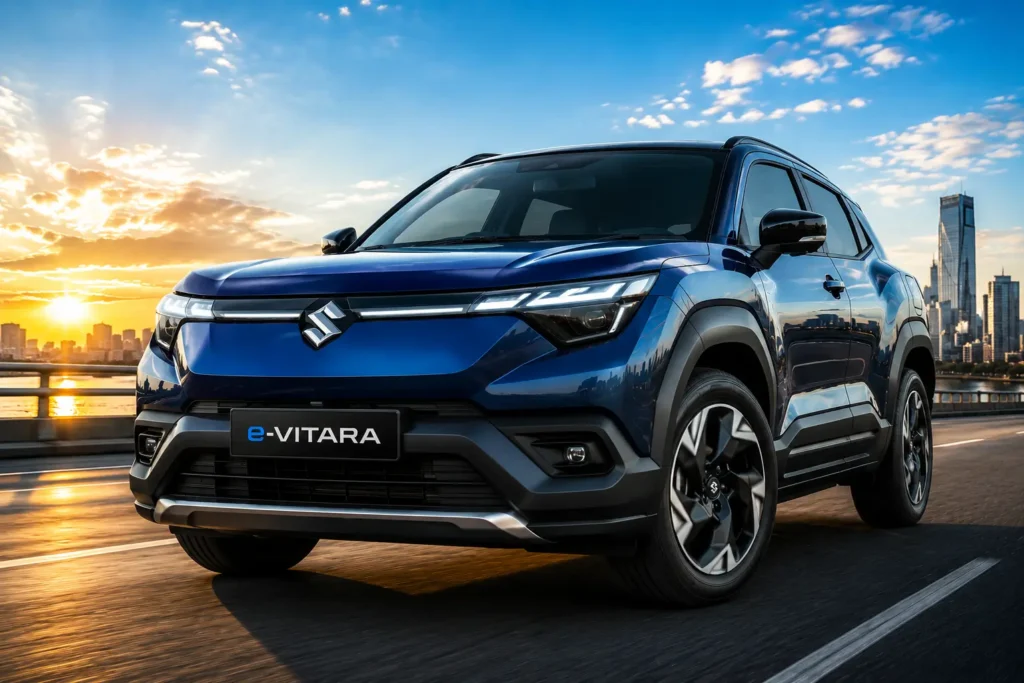
Let’s be honest — nobody really expected Maruti to go electric this seriously, this soon.
We all know what Maruti means in India. It’s the first car in most families. The one parked outside the gate in every colony, from Gomti Nagar to Alambagh. So when Maruti finally said “we’re going electric,” people didn’t just notice — they stopped scrolling. And now with the e-Vitara actually arriving, the question isn’t whether to look at it. The question is which version makes sense for you.
Two battery options. Very different use cases. And if you’re in Lucknow, a very specific on-road price that nobody seems to be talking about clearly. Let’s fix that.
It’s Maruti’s first proper electric SUV — not a hybrid, not a mild electric, a full battery electric vehicle. Built with Toyota on a platform designed from day one for EVs. That matters more than it sounds, because a lot of “electric cars” in India are basically old petrol platforms with a battery shoved in. The e-Vitara isn’t that.
Size-wise, think Grand Vitara. Same road presence, similar dimensions. But underneath, it’s a completely different machine. The weight sits lower, the handling feels sharper, and the silence when you put your foot down is genuinely something you have to experience once to understand.
There are two options from Maruti: one is a rental battery EMI, and the other is a full purchase
Now here’s where Lucknow buyers need to pay attention. UP road tax is not cheap — expect 8 to 10 percent on top of the ex-showroom price. Add first-year insurance (₹35,000 to ₹45,000, depending on variant), registration, and handling, and your actual on-road number will add up more.
One thing worth checking — UP has an EV purchase incentive under its state EV policy. It doesn’t always get advertised upfront at dealerships, so ask specifically. It can knock off a meaningful amount from what you finally pay.
Everything else — the infotainment, the safety kit, the design — is the same across variants. The battery choice is where your decision actually lives.
The 49 kWh is for the person whose life happens inside Lucknow.
ARAI says 450 to 480 km. Real world in city traffic? Closer to 360 to 400 km. On the highway with the AC on at 100 km/h, plan for 300 to 340 km. If your daily drive is under 80 km — office, kids’ school, grocery, the occasional Hazratganj outing — you are charging maybe once a week at home. DC fast charging gets you 10 to 80 percent in around 50 minutes. That’s a lunch break, not an inconvenience.
Honest opinion? For 80 percent of Lucknow buyers, the 49 kWh is enough. More than enough.
The 61 kWh is for people who leave the city regularly.
The ARAI number here is around 550 to 580 km, and real-world highway range sits at 400 to 440 km. Now do the math — Lucknow to Delhi is roughly 500 km. The 61 kWh covers it on a single charge under normal driving conditions. No charging stop on the expressway. Just drive. For anyone doing that route even once a month, or regularly heading to Kanpur, Varanasi, or Agra, the extra ₹3 to 5 lakh starts making a lot of sense. Fast charging is marginally longer — about 55 to 60 minutes to 80 percent — but you’ll barely notice the difference in practice.
Maruti has genuinely surprised people with this cabin. It doesn’t feel like a budget compromise anywhere. Large touchscreen up front, wireless Android Auto and Apple CarPlay, a fully digital instrument cluster that’s actually readable in sunlight, and Suzuki Connect with 40+ connected features — including being able to control things from your smartwatch, which honestly still feels a bit futuristic for a Maruti.
Higher trims get ventilated seats (very useful in Lucknow summers, let’s be real), a panoramic sunroof, and a Head-Up Display. Ground clearance is around 200 mm — comfortable for city roads, those brutal speed breakers near older localities, and the occasional waterlogged underpass during monsoon season. Suspension feel is sorted, not stiff.
On safety — 6 airbags as standard across every variant, 360-degree camera, ESP with Hill Hold, TPMS, and Suzuki’s TECT steel platform. This isn’t a car that cut corners to hit a price point.
If Lucknow is your world — the 49 kWh. Save the money, enjoy the car, charge at home on weeknights.
If the expressway is a regular part of your life — the 61 kWh, no second thoughts.
And honestly, whichever you pick, you’re getting something no other EV brand in India can give you right now — a Maruti service centre within a few kilometres of wherever you live. That’s 4,000+ outlets nationwide, multiple NEXA showrooms in Lucknow alone. For a lot of first-time EV buyers, that peace of mind is worth more than any spec sheet number.
Go to your nearest NEXA in Lucknow, sit in it, ask for the test drive, and book early. Waiting periods on this one are going to get long very quickly.
Also worth reading: Grand Vitara vs Hyryder Hybrid — Should You Go Full Electric or Play It Safe With a Hybrid in 2026?