Physical Address
304 North Cardinal St.
Dorchester Center, MA 02124
Physical Address
304 North Cardinal St.
Dorchester Center, MA 02124

Latest Car News, Reviews, Comparisons & EV Updates
Latest Car News, Reviews, Comparisons & EV Updates
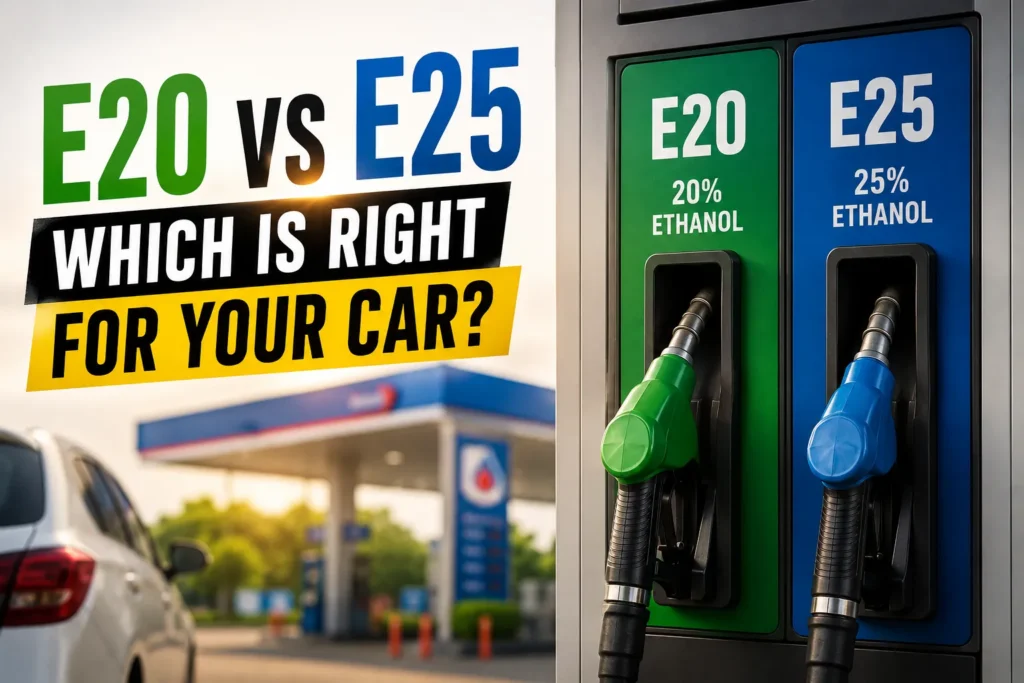
E20 vs E25: When you stop at a fuel station to fill up your car, take a look at the fuel pump. A big change is happening in India and many other countries. Regular petrol is being replaced with petrol mixed with ethanol. This is because governments want to make transportation cleaner and more sustainable.
In recent years, you may have noticed E10 and E20 fuels at many stations. Now E25 fuel could be the option. This means you will soon have to decide which type of fuel to use.
What do E20 and E25 fuels mean? How are they different from petrol? Will using these fuels affect how your car runs, how much fuel it uses, or how long the engine lasts? Will it cost more to maintain your car? Let’s break it down,
The numbers are easy to understand. E20 means the fuel is twenty percent ethanol and eighty percent petrol. E25 means twenty-five percent ethanol and seventy-five percent petrol. Ethanol is a biofuel made from crops like sugarcane, maize, or agricultural waste. When you blend it into petrol, it helps reduce our dependence on imported oil and cuts down on pollution. Countries like India, Brazil, and the US are all increasing their ethanol blending programmes. Ethanol blending programmes are good for the environment. They help farmers. They also keep money in the country.
Moving from E20 to E25 does not seem like a deal. That extra five percent ethanol makes a difference. Ethanol has more energy per litre than petrol, so E25 has slightly lower energy density. This can affect your fuel economy. It is not a difference, though. On the other hand, E25 burns cleaner. It produces carbon dioxide emissions, less carbon monoxide, and fewer particles. E25 also has an octane rating higher than E20, which means more efficient combustion in engines that can handle E25.
This is where it gets personal. Most cars made after 2015 can handle E20. E25 is more demanding. A higher ethanol content can damage rubber seals and stress fuel lines. It can also cause wear on injectors. Two-wheelers and smaller engines are more sensitive. Before switching to E25, check your owner’s manual. Call the manufacturer. Car makers in India are already making E20 and E25-compatible engines. If you’re buying a vehicle, compatibility is becoming standard.
Both E20 and E25 are better for the planet than petrol. E25 has an edge over E20 in reducing greenhouse gases. It depends on how the ethanol was made though. Sugarcane-based ethanol has one of the lowest carbon footprints. If the environment matters to you th, it is worth knowing.
If you drive a vehicle or want fuel that’s easy to find, E20 is a choice. E25 makes sense if your vehicle can handle it, it’s available in your area, and you want to reduce your carbon output. Higher blends are being introduced. Being starts with knowing what your engine can handle.
If you’re interested in how ethanol-blended fuels could impact your vehicle, these related articles provide deeper insights into E25 petrol, flex-fuel technology, fuel efficiency, and alternative powertrains.
E20 vs E25, E20 vs E25, E20 vs E25, E20 vs E25, E20 vs E25, E20 vs E25,